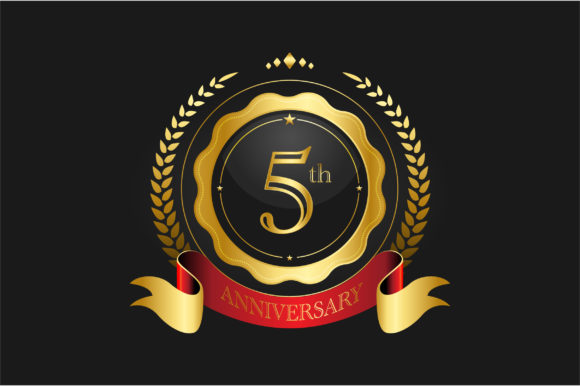
Evaluating the 5th Anniversary 3d Badge Illustration for Professional Branding Needs
When marking a significant milestone, such as a five-year anniversary, visual communication plays a pivotal role in conveying trust, longevity, and achievement. The 5th Anniversary 3d Badge Illustration has emerged as a popular asset for designers and business owners seeking to celebrate this occasion with a sense of permanence and prestige. Unlike flat, minimalist icons that might feel transient or overly casual, a three-dimensional badge carries weight. It suggests substance, history, and a tangible commitment to quality.
For professionals aged 20 to 50 who are navigating the complexities of brand identity, choosing the right visual element is not merely an aesthetic decision; it is a strategic one. This article provides a practical evaluation of the 5th Anniversary 3d Badge Illustration, examining its technical specifications, design philosophy, and suitability for various digital and print applications. By comparing it against alternative design approaches, we can determine when this specific asset offers the best value and where other options might serve your project better.
Understanding the Design Philosophy: Timelessness Through Dimension
The core appeal of the 5th Anniversary 3d Badge Illustration lies in its stylistic choice to employ a "timeless" feel. In graphic design, timelessness often refers to aesthetics that resist fleeting trends. While neon gradients and glassmorphism may dominate social media feeds for a season, a well-executed 3D badge tends to rely on fundamental principles of light, shadow, and geometry. These elements create a sense of realism that translates well across different mediums.
This illustration utilizes a suitable color palette designed to evoke stability and celebration. Typically, such designs incorporate deep blues, rich golds, or muted earth tones—colors associated with heritage and success. The three-dimensional aspect adds depth, allowing the badge to stand out against both light and dark backgrounds without requiring complex layout adjustments. For a website header, a certificate footer, or a social media post, the badge acts as a focal point that draws the eye immediately.
However, it is important to note that "3D" in digital assets does not always mean fully rendered photorealism. Often, these illustrations use stylized shading and perspective to suggest volume while maintaining a clean, vector-like crispness. This hybrid approach ensures that the image remains sharp at any resolution, which is crucial for professional use. The distinction between a cheap clip-art icon and a premium 3D badge is often found in the nuance of the lighting and the subtlety of the textures used.
Technical Versatility and File Formats
One of the most significant advantages of acquiring the 5th Anniversary 3d Badge Illustration in a comprehensive package is the variety of file formats included. A robust asset library should cater to different stages of the design process, from initial sketching to final export. The inclusion of AI (Adobe Illustrator), EPS (Encapsulated PostScript), JPG (JPEG), SVG (Scalable Vector Graphics), and raw image files addresses the needs of diverse workflows.
- Vector Files (AI, EPS, SVG): These are essential for scalability. If you need to enlarge the badge for a large banner or reduce it for a favicon, vector formats ensure no loss of quality. The AI and EPS files allow for deep editing, enabling you to change colors, adjust shapes, or modify text to fit specific branding guidelines. This editability is a critical factor for agencies working on custom projects where consistency is key.
- Raster Files (JPG): JPEGs provide immediate usability for web pages, email newsletters, and presentations where vector editing software is not required. They offer a quick preview and easy integration into non-design tools like Microsoft PowerPoint or Canva.
- SVG Specifics: As a scalable vector format, SVG is particularly powerful for modern web development. It allows for CSS styling, meaning you can animate the badge or change its color dynamically via code, adding an interactive layer to your anniversary campaign.
Comparing this multi-format bundle to single-file purchases reveals a clear tradeoff. While some free resources might offer only PNGs, they lack the flexibility needed for professional customization. The ability to open the source file and tweak the gradient stops or the drop shadow gives the designer control over the final output, ensuring it aligns perfectly with the client’s existing brand palette.
Comparison with Alternative Design Approaches
To make an informed decision, it is helpful to compare the 3D badge approach with other common methods for celebrating anniversaries. Each style serves different psychological triggers and contextual needs.
Flat Design vs. Three-Dimensional Depth
Flat design has been dominant in tech and startup culture for the past decade due to its clarity and speed of loading. A flat "5 Years" badge is clean, modern, and unobtrusive. However, it can sometimes feel ephemeral or less celebratory. The 5th Anniversary 3d Badge Illustration, by contrast, leverages depth to create a sense of importance. If your goal is to highlight a legacy, a physical product line, or a service with a long track record, the 3D style communicates durability better than flat graphics. The tradeoff is that 3D assets can be heavier and require more careful placement to avoid cluttering the interface.
Typography-Only Badges vs. Illustrated Icons
Another alternative is using bold, custom typography to display the number "5" or the word "Anniversary." This approach relies entirely on font choice and layout. While elegant, it requires strong typographic skills to execute well. An illustrated badge provides a ready-made graphical anchor. It reduces the cognitive load on the viewer by providing a recognizable symbol of achievement. For businesses that do not have an in-house design team, the pre-made illustration saves time and ensures a polished look without the risk of poor typographic execution.
Photography vs. Illustration
Some brands prefer to use photographs of their team or products alongside anniversary text. While authentic, photos can vary in lighting and composition, making consistent branding difficult. A 3D badge offers uniformity. Whether placed on a homepage, a thank-you card, or a merchandise item, the badge maintains its visual integrity. This consistency is vital for building brand recognition over time.
Best-Fit Situations and Limitations
Deciding whether to use the 5th Anniversary 3d Badge Illustration depends largely on your specific context. It is an excellent choice for:
- Digital Product Launches: Software companies or app developers celebrating a major version update or user milestone can use the badge to signal reliability and growth.
- E-commerce Trust Signals: Online stores can place this badge near checkout buttons or in the footer to reassure customers of their established presence. The 3D effect adds a touch of premium quality to the shopping experience.
- Corporate Communications: Annual reports, press releases, and internal newsletters benefit from the formal yet celebratory tone of a 3D badge. It elevates the document’s perceived value.
- Merchandise Design: Because the vector files are editable, the badge can be adapted for printing on t-shirts, mugs, or plaques. The high-resolution nature of the source files ensures that prints remain crisp and detailed.
However, there are limitations. The 3D style may not suit brands with a strictly minimalist or ultra-modern aesthetic that rejects skeuomorphism (the simulation of real-world textures). Additionally, if the target audience consists primarily of users on low-bandwidth connections or older devices, heavy 3D graphics with complex shadows might slow down page load times unless optimized correctly. In such cases, using the SVG format with minimal effects or a simplified JPG version would be a necessary compromise.
Evaluating Value and Customization Potential
The statement that the design is "easy to use and can be edited as needed" is a crucial selling point for professionals. Many purchased assets are locked or flattened, forcing the buyer to work around the original design constraints. With accessible AI and EPS files, the 5th Anniversary 3d Badge Illustration becomes a modular component rather than a static image. You can swap out the gold accents for your brand’s primary color, adjust the size of the central emblem, or integrate additional text elements seamlessly.
This level of customization transforms the asset from a generic decoration into a tailored brand element. It allows for a cohesive narrative where the anniversary badge feels like an integral part of the company’s visual language, rather than an add-on. For agencies managing multiple clients, this editability reduces production time significantly, as the base structure is already established and polished.
Conclusion on Suitability
The 5th Anniversary 3d Badge Illustration represents a thoughtful intersection of aesthetic appeal and technical utility. Its strength lies in its ability to convey tradition and achievement through dimensionality, while its multi-format support ensures compatibility across modern design workflows. When compared to flat alternatives, it offers greater visual impact and emotional resonance, making it ideal for brands looking to emphasize their longevity and reliability.
For professionals evaluating their options, the decision should hinge on brand voice and technical requirements. If your brand values heritage, prestige, and tangible quality, this 3D badge is a strong candidate. If your priority is ultra-minimalism or rapid prototyping, a simpler flat icon might suffice. Ultimately, the availability of editable vector files empowers the designer to bridge the gap between a stock asset and a bespoke brand element, ensuring that the celebration of the fifth anniversary enhances, rather than distracts from, the overall user experience.